
You will discover the importance of Burmese pythons in the Everglades and what actions can be taken if one is spotted. These large, nonvenomous constrictors have established breeding populations throughout South Florida and are a critically important factor in the decline of native mammals and changes in the food web of the Everglades.
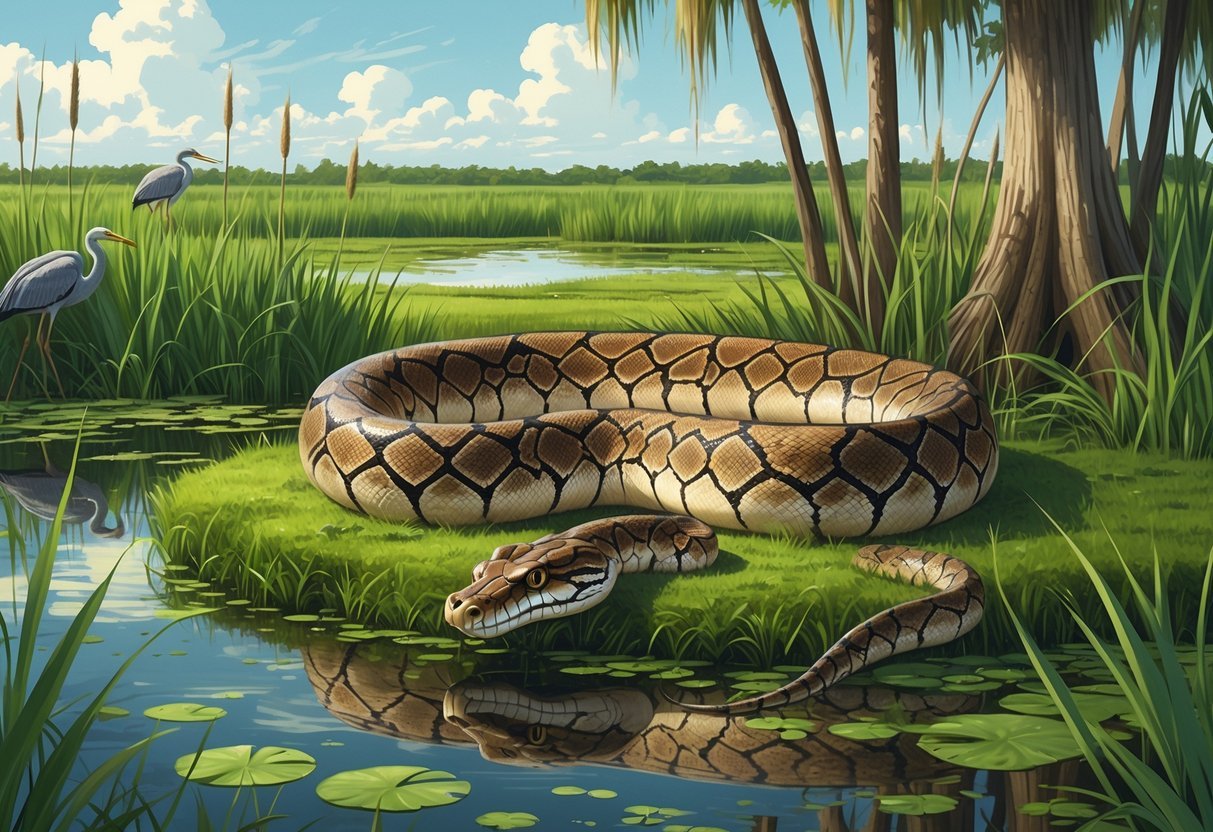
This article will provide accurate information on how to identify pythons, their habitats, diet, and their impact on the ecosystem. It will also offer practical advice on management efforts,opportunities for public involvement such as removal programs,and how to report sightings.
The Presence of Burmese Pythons in Florida’s Everglades
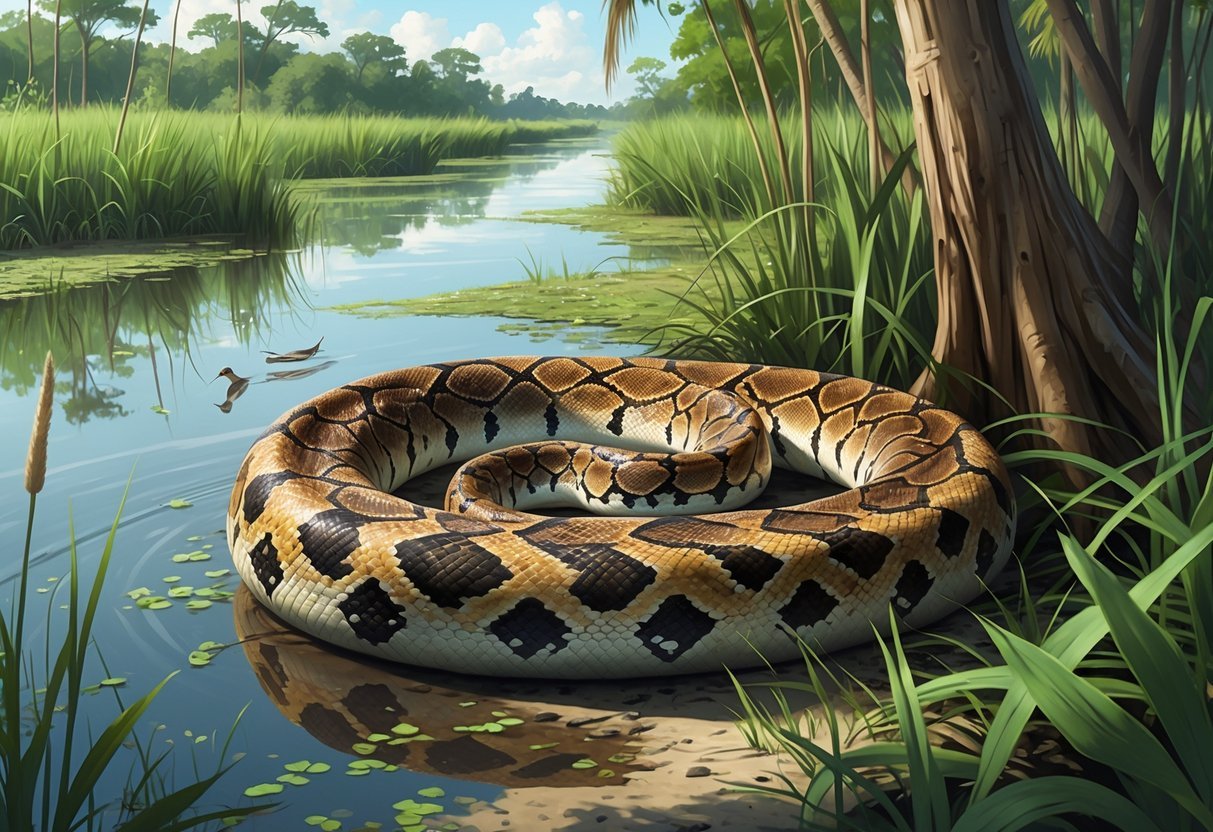
Burmese pythons have become a dominant predator that is challenging to detect in southern Florida. They have established breeding populations that substantially affect native wildlife. This article will provide details on how they were introduced to this area, where they currently reside, and an estimation of their population size.
History of Introduction to The Everglades
In the 1980s, Burmese pythons (Python bivittatus) were first discovered in southern Florida. Many of these snakes were originally pets, but they were either intentionally released or escaped during hurricanes and damage to breeder facilities. Notably the initial source of these pythons was from the pet trade in Miami. Over time,these released and escaped individuals adapted to the subtropical wetlands of the Everglades and began reproducing.
By the 1990s and 2000s, evidence of breeding was found in Everglades National Park and surrounding public lands. The Florida Fish and Wildlife Conservation Commission (FWC), National Park Service, and US Fish & Wildlife Service attribute this invasion primarily to human activities related to the exotic pet market.
Prevention measures such as regulations and public outreach have been implemented in an effort to reduce new introductions.
Distribution And Range In Southern Florida
Burmese pythons are mainly concentrated in Miami-Dade, Monroe, and Collier counties with most sightings occurring within or near the Florida Everglades. they can be found near wetlands, marshes, and canals where they prey on mammals, birds, and other reptiles.
The vast connected freshwater habitats within Everglades National Park make it a core stronghold for Burmese pythons.However,sightings have also been reported on adjacent state and federal lands.
While there have been occasional reports of python sightings moving northward along suitable corridors, established breeding populations are mostly confined to southern Florida’s wetland areas. Management agencies use targeted surveys and also detection dogs to map their distribution. It is important to note that habitat suitability rather than political boundaries determines where pythons remain abundant.
Population Size And Growth
Determining an accurate population size for Burmese pythons is challenging as they are cryptic and reproduce in low-visibility habitats. Though, scientific estimates suggest there could be tens of thousands of individuals in the Everglades region. It is indeed also critically important to note that population growth likely accelerated after their initial establishment due to an abundance of prey and few natural predators for adult pythons.
Studies have shown a significant decline in medium-sized mammal sightings within Everglades National Park, which can be attributed to python predation. This suggests that even with uncertain total snake numbers, their impact on the ecosystem is ample.
Management efforts such as python removal teams and public removal events aim to reduce local populations, but long-term suppression across the entire Everglades remains a challenge.
Physical Characteristics And Identification

This section will provide information on how to identify Burmese pythons based on size, patterning, behavior, and other key characteristics that distinguish them from native or other non-native large snakes.
Size And Appearance
In southern Florida, adult Burmese pythons (Python molurus bivittatus) can reach lengths of 10-16 feet with some exceeding 17 feet.Females are typically heavier than males and large adults can weigh between 50-150+ pounds depending on recent feeding.
Their coloration consists of tan or cream backgrounds with irregular dark brown blotches outlined in black. Juveniles may display brighter contrast but this dulls with age.
Their heads are broad with a dark crown and light stripes running from the eye to the snout, forming a V-like pattern. Their scales are smooth and their bellies are lighter with irregular spots.
If needed, precise identification can be made by measuring snout-to-vent length or counting subcaudal scales.
Comparison With Native And Other Invasive Snakes
Burmese pythons can be distinguished from native species by their size and blotch pattern. Native Florida boas and indigo snakes are smaller in size and have different head shapes and patterning.
Boa constrictors (introduced elsewhere) have more defined saddle-like markings and a narrower head profile compared to Burmese pythons. Northern African pythons (Python sebae) may overlap in size but typically have larger, more continuous dorsal patches and different head scalation.
Unlike venomous snakes, Burmese pythons are nonvenomous constrictors. If you come across a snake with a huge girth and puzzle-piece blotches, it is indeed likely a Burmese python rather than a venomous species.
Behavior And Adaptations
Burmese pythons primarily rely on ambush tactics to capture prey. they use their cryptic coloration to blend in with their surroundings while waiting for mammals, birds, or even alligators to pass by. They can be found in wetlands, tree islands, or canal edges where they use both ground cover and low vegetation for hunting as well as thermoregulation purposes.
In Florida’s climate, they reproduce prolifically with females laying large clutches of eggs that they will then coil around for temperature regulation until hatching. Pythons swallow prey whole which allows them to fast for months after a large meal. Their secretive movements and cryptic habits make them difficult to detect, increasing their impact on the Everglades ecosystem.
Habitat And Ecology In The Everglades Ecosystem
Burmese pythons are mainly found in freshwater marshes, tree islands, and canal edges where prey is abundant and cover is dense. Their distribution within the Everglades is influenced by water levels, vegetation structure, and access to both aquatic and terrestrial prey.
Preferred Habitats And Wetlands
Pythons prefer sawgrass marshes, cypress domes, and mangrove fringe habitats where water levels fluctuate seasonally.These areas provide submerged or emergent vegetation for concealment as well as ample access to rodents, rabbits, marsh birds, and larger mammals such as white-tailed deer.
They can also be found along canal banks or levee edges which serve as movement corridors and hunting sites due to the concentration of prey in these areas.
It should be noted that habitat selection may shift with age or season. Juveniles tend to use drier upland microhabitats for refuge while adults will move across wetter areas during breeding or nesting seasons.
Adaptability And Survival Strategies
Burmese pythons are able to thermoregulate by utilizing both sun-exposed banks for warmth as well as shaded marsh interiors for cooling down.This allows them to maintain digestion and reproduction even in Florida’s hot climate.
You will now understand whyWater Management District: 1-800-432-2045
You can also report sightings through the FWC’s online reporting tool or by downloading the IveGot1 app.
Rewritten Article:
Exploring the diverse microclimates of the Everglades, you may come across female Burmese pythons selecting warm, insulated nest sites to raise their eggs. These cryptically colored snakes are skilled at blending into their surroundings and moving stealthily through sawgrass and mangrove roots. They have a broad diet, which allows them to adapt to changes in prey availability.
In addition to their natural habitat, pythons have also adapted to human-altered environments such as canals and edges of wetlands. This has expanded their range beyond core areas and made it challenging for management efforts in the Everglades. Studies using radio-tracking and nest monitoring have shown that adult pythons can travel long distances between feeding and breeding sites, highlighting the importance of landscape connectivity in managing this invasive species.
Burmese pythons are opportunistic predators that consume a variety of animals including mammals, birds, and reptiles.Their hunting strategy involves using heat-sensing pits to detect warm-blooded prey before striking quickly and constricting until suffocation occurs. Despite being able to take down large prey like deer or feral hogs when available,these snakes do not feed frequently; a large python may only eat a few times per year.Their diet is influenced by seasonal changes in prey availability and also habitat use within the Everglades. This broad diet helps them persist as an invasive species introduced primarily through the exotic pet trade.
The presence of Burmese pythons in the Everglades has had a significant impact on native species. Studies have shown dramatic declines in populations of mid-sized mammals such as marsh rabbits,raccoons,opossums,and ground-nesting birds due to python predation. This loss has a cascading effect on the food web, leading to changes in predator-prey dynamics and altering vegetation through shifts in herbivore pressure. The presence of pythons also poses a threat to endangered or at-risk species, making conservation efforts more challenging.While alligators are the primary native predator and competitor for Burmese pythons in the Everglades, they are not enough to control their population. Competition also occurs with other large predators for overlapping prey resources. Human-mediated factors such as escaped or released exotic pets have contributed to the spread of this invasive species and make natural control difficult.The presence of Burmese pythons has not only affected native animals but also altered ecosystem processes within the Everglades. Their removal from the food web has led to changes in grazing pressure, plant regeneration rates, and nutrient cycling across different habitats. This imbalance is further amplified by other stressors such as habitat loss and human disturbance.
To address this issue, various agencies have implemented management programs aimed at removing and monitoring python populations. The Florida Fish and Wildlife Conservation Commission (FWC) coordinates statewide efforts through their Python elimination Program which trains contractors and law enforcement personnel in safe capture methods. they also run public removal events like the Florida Python Challenge which raises awareness about this issue while removing hundreds of snakes each year.
The South Florida water Management District (SFWMD) hires paid python removal contractors who work on public lands and canal systems within their jurisdiction. They target high-risk habitats for removals while coordinating with neighboring land managers to cover large wetland areas effectively.
Community involvement is crucial in managing Burmese pythons in the Everglades. Citizen-science sighting reports, local removal networks, and organized search teams supplement agency efforts. Prevention campaigns also play a vital role in reducing future introductions of this invasive species through education and alternative options for pet owners.
If you spot a Burmese python in the Everglades, do not attempt to capture or approach it. Instead, report the sighting to the appropriate agency with accurate information such as photos, location, and behavior observed. By working together and taking necessary precautions, we can definitely help manage this invasive species and protect the unique ecosystem of the Everglades.(Everglades/Monroe/Collier/Miami-dade): If you come across nonnative species in these areas, it is important to report them to the Florida Fish and Wildlife Conservation Commission (FWC). This can be done through their online form or by contacting their Nonnative species reporting hotline.
For national parks or preserves,the National Park Service has specific reporting procedures that should be followed. It is important to use these official channels when reporting sightings of nonnative species.
In case of urgent threats to people or pets, it is advised to call 911 for immediate assistance.
When making a report, please include the following details: date, time, and precise location (if possible with lat/long coordinates), number of snakes and estimated size, photographs or short video evidence, and any distinguishing features such as color pattern, tags or injuries.
To spread accurate information about nonnative species and educate others on how to handle sightings properly,it is indeed recommended to use official channels and community groups. You can also follow FWC, USGS and local park pages for identification guides and updates on removal efforts. Additionally, keep an eye out for training opportunities provided by these sources.
If you want to share your sightings on social media platforms like facebook or Twitter/X make sure you do so carefully. Only post photos and location information in trusted groups or official agency pages. If agencies provide a confirmation number for your report then include it in your post as well. On Twitter/X tag agency accounts and use official hashtags related to nonnative species in order increase visibility.
There are various resources available for learning more about nonnative species in Florida as well as getting involved in efforts towards their removal from native habitats:
– Identification sheets and maps from university extension services
and FWC.
– Volunteer/python-decontractor programs coordinated by SFWMD
and FWC.
– Citizen science platforms that aggregate verified sightings.
It is important to avoid sharing unverified rumors or sensational images related to nonnative species. This helps keep response efforts focused and protects native wildlife.


These pythons have wreaked havoc on the Everglades ecosystem.