
if you’ve attended a reptile expo in recent years, chances are you’ve come across the impressive artwork of Tell Hicks. Whether it’s his original paintings or the various t-shirt and hat designs sold by Ecowear Publishing, Tell’s work is hard to miss. he can often be found at these expos, working on a new painting while engaging with visitors.
Courtesy tell hicks
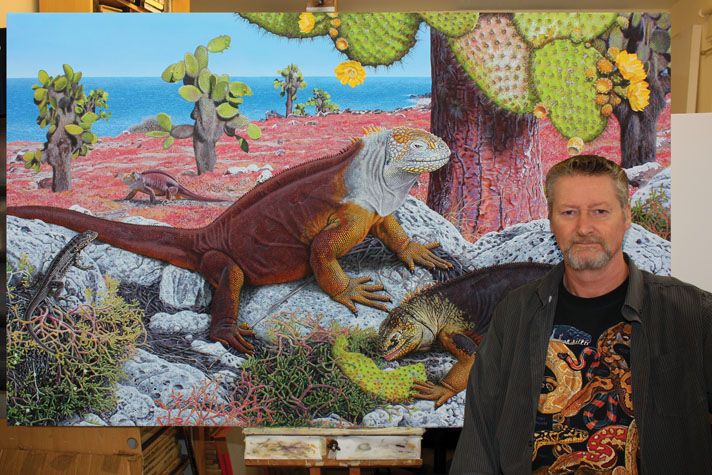
The Galapagos Islands have been a major source of inspiration for Tell’s paintings, including this stunning piece featuring land iguanas.
With his reptile artwork gaining popularity, we thought it was time to sit down with Tell Hicks and learn more about his art and himself.
REPTILES: Can you tell us about yoru background as an artist? Did you recieve any formal training or schooling? Who where some of your early inspirations?
Tell Hicks: I have always had a passion for art as I was very young. As a child, I would fill sketchbooks with drawings of animals and people. I even had a collection of portraits of neighborhood pets.
courtesy tell hicks
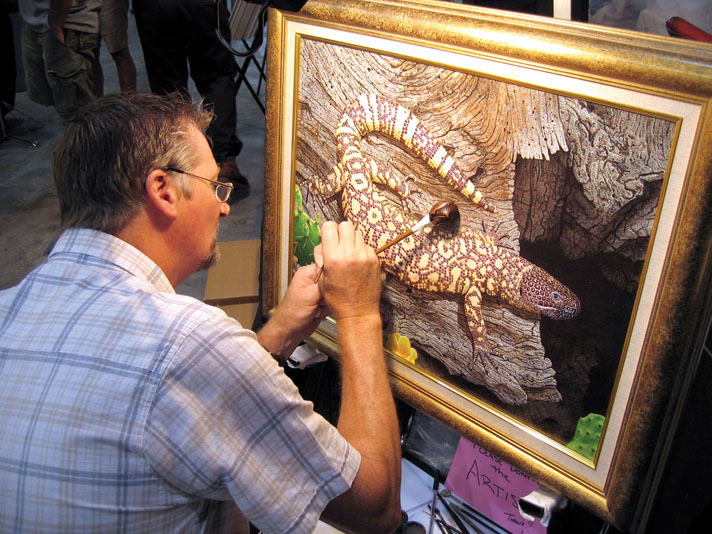
Tell working on a Gila monster painting at a show in 2006.
Throughout my school years, my paintings were always displayed on the classroom walls. I knew from a young age that I wanted to be an artist,and that passion has stayed with me throughout my life.
At the age of 9, I was given the book Prehistoric Animals, illustrated by Zdenek Burian. His work continues to inspire me today. His paintings were imaginative and exciting. I also drew inspiration from early wildlife programs by naturalist David Attenborough and portfolios of paintings by traveling artists/naturalists such as Audubon and Gould.
When I was 17, instead of going to college, my desire for travel and adventure led me away from home and school. At 19, with only $300 in my pocket, I hitchhiked across Europe and Asia through Iran, Afghanistan, and India. Along the way, I would sketch reptiles and other wildlife that caught my eye. Eventually, I arrived in australia with no money left.
REPTILES: Have you always been interested in herps? Do you have any favorite species?
Tell hicks: My fascination with animals began at a young age. My parents became accustomed to me bringing home orphaned baby birds or injured wildlife found in our neighborhood.
Courtesy Tell Hicks
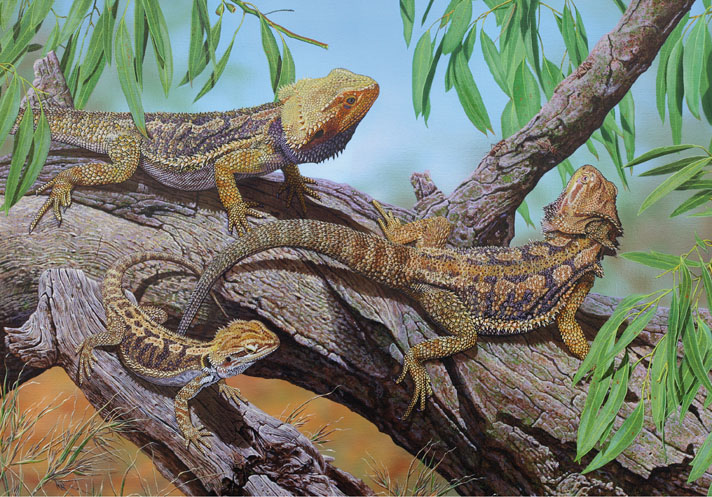
Bearded dragons.
When my family moved to Buckinghamshire when I was 10, I discovered a colony of European adders near our house. I spent every spare moment observing and sketching them. During one of these outings, I met snake expert Tony Phelps. He became a close freind and mentor, and we spent many years traveling around the UK studying native herpetofauna and promoting conservation efforts. It was Tony who encouraged me to pursue zoo work, and I have fond memories of our adventures with crocodiles, cobras, and other exotic species.
I currently keep a few reptiles at home. In recent years,I have focused on breeding eastern and western fox snakes. However,european vipers remain my favorite species.
REPTILES: What is your preferred medium for painting?
Tell Hicks: As a self-taught artist, I have experimented with various mediums over the years. For some time, I developed new techniques in egg tempera painting – an ancient method that uses egg yolk as a binding agent for pigments. It’s a challenging medium that requires discipline in both preparation and application processes; however, the results are worth it.
These days, I use alkyd Oil Paints – fast-drying oil paints that are highly permanent. They allow me to continue using techniques developed with egg tempera while being more practical for painting at shows where paintings need to be packed away “dry” at the end of each day.
I also continue to create t-shirt designs for Bob and Sheri Ashley at Eco Publishing using digital technology rather of hand-drawn separations with ink on film. However, the process is still time-consuming.
REPTILES: While you are well-known for your herp paintings, do you also paint other types of wildlife?
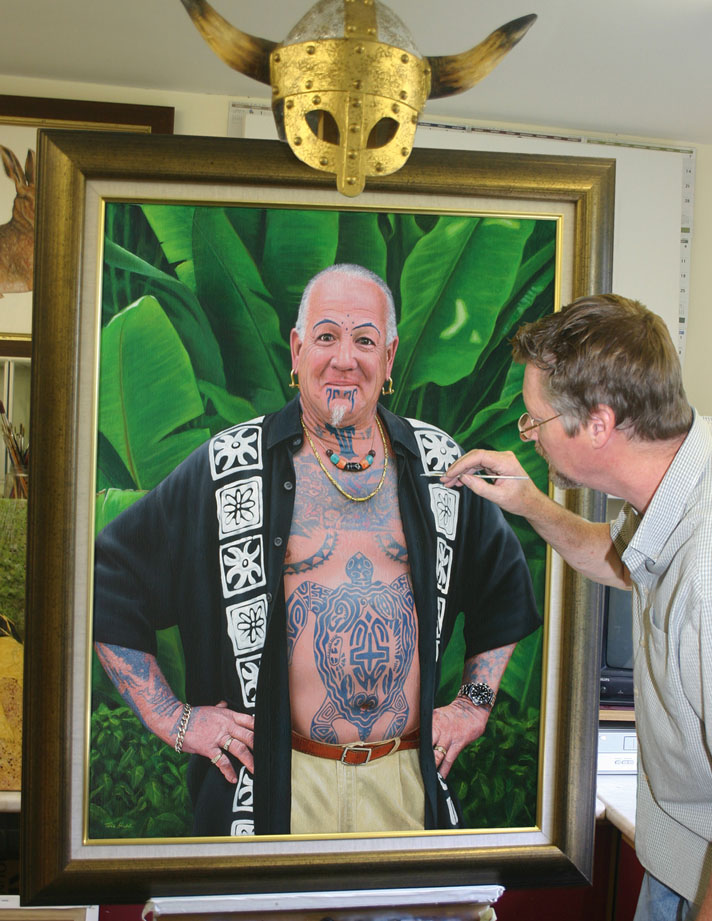
Tell Hicks: Reptiles are my passion, and I have primarily focused on them in my work. however, I consider myself an all-round naturalist. Over the years, I have painted many non-reptile subjects, including mammals and birds. I also enjoy painting human portraits.
courtesy tell hicks
While he’s known for his reptile paintings, Tell Hicks also enjoys painting portraits like this one of “Tattoo Pete” Gardiner.
When I’m out herping, I am always on the lookout for interesting plants to photograph.You never no when they may come in handy as a background element in a future composition.
REPTILES: Can you walk us through a typical day when working on a painting?
Tell Hicks: Fellow artists often joke about how productive I am; however,it’s not because I am a fast painter.My technique involves building up layers of thin paint which can be time-consuming.
I usually start my day in the studio at 9 am with breaks for meals and checking on my fox snakes and turtles.I work until around 6 pm, sometimes later if I am in the middle of a project.
REPTILES: How do you come up with ideas for your paintings?
Tell Hicks: Inspiration can come from anywhere – a photo, an idea that pops into my head, or even a dream. Sometimes it’s just a matter of sitting down and starting to paint without any specific plan in mind.
I also take inspiration from my travels and experiences with reptiles in the wild. Such as, after visiting the Galapagos Islands, I was inspired to create several paintings featuring land iguanas.
REPTILES: What has been your most memorable experience as an artist?
Tell Hicks: There have been many memorable moments throughout my career as an artist. Though,one that stands out is when I was commissioned by National Geographic Magazine to create illustrations for their book The Ultimate Reptileopedia: The Most Complete Reptile Reference Ever.it was an amazing opportunity and honor to be involved in such a prestigious project.

courtesy tell hicks
Garter snake.
Working as a wildlife artist, my days are often long and unpredictable. I typically start my workday at 9 am and continue until 9 pm, with occasional late nights if there is a pressing deadline. Though, my wife Eileen always reminds me to take breaks and spend time with her.
When asked about the pivotal moments that led me to where I am today in my career, I must say it has been a challenging journey. As most aspiring artists will tell you, success in this field is not easy to achieve. Being a parent and having financial responsibilities have forced me to take on other jobs from time to time just to make ends meet. My understanding wife Eileen has been supportive of my artistic pursuits despite the uncertainty that comes with it.I have had opportunities to work for various publishing companies over the years but decided instead to self-publish my own prints. This gives me more control over the subject matter of my artwork but also requires significant financial investment and extra effort in promoting them.
My relationship with Bob and Sheri Ashley began many years ago when we met at the Reptile Breeders Expo in Orlando, Florida. Our friendship quickly turned into a strong professional partnership, and they now represent me in the US market through their company Ecowear. They constantly encourage me to take on new challenges, and I consider them family.
Their Chiricahua desert Museum in Rodeo, New Mexico proudly displays a large collection of my artwork including an 8-by-4-foot mosaic of a Gila monster and a 16-foot-tall metal sculpture of a rattlesnake’s tail.
Many years ago, Hewlin Design -a t-shirt company based in Wales- discovered my work and inspired me to create t-shirt designs for them. We have remained great friends ever as, and I am grateful for their support.
Most of my artwork is now done on commission, and I am incredibly grateful to my clients who appreciate and value my work. Their patronage allows me to continue pursuing my passion as a professional artist.
When it comes to finding inspiration for my paintings, Australia has always been a favorite destination. However, in recent years I have fallen in love with the US Southwest after numerous trips there.In 2012, I had the opportunity to visit the Galapagos Islands with a group of herpetologists, and it was an unforgettable experience. The unique wildlife and landscapes of this place have left a lasting impression on me, and I could happily spend the rest of my life painting them.
I have had many interesting experiences during my travels as an artist. One that stands out is when Eileen accompanied me on a trip to Cyprus where we combined a family holiday with searching for Europe’s largest viper -the blunt-nosed viper (Macrovipera lebetina). After following detailed directions from a friend who had recently seen one, we found ourselves driving further away from civilization into remote areas of the island. Eileen was understandably worried about being stranded without any means of dialog if something happened to me while searching for snakes. As we approached our destination according to her map reading skills, we suddenly came across what appeared to be a large snake in the middle of the road. Excitedly jumping out of our car in pursuit, I soon realized it was not the viper but still worth photographing -a fast-moving whip snake known for its formidable bite! In all this excitement however I forgot to explain this harmless encounter with Eileen before limping back towards her car which only added fuel to her already anxious state.
You may sometimes find me working on paintings at reptile shows which can be quite diffrent from working alone in my studio. Though interacting with people while painting live has never been a problem for me, and I enjoy the experience.my journey as a wildlife artist has been filled with challenges and memorable experiences. I am grateful for the support of my family, friends, and clients who have made it possible for me to pursue my passion. And I look forward to many more adventures in the world of art and reptiles.Rewritten Article:
Tell Hicks is a renowned artist known for his unique technique of building up layers of underpaint in his paintings. This often results in chaotic and unrecognizable images during the initial stages, but eventually transforms into a finished masterpiece. Hicks prefers to reach a stage where the image is understandable before showcasing it at a show,allowing the public to witness the process of creating art.
One interesting aspect of Hicks’ work is that he uses fast-drying pigments, which allows him to involve members of the public in his paintings. He enjoys letting people, especially children, add their own brush strokes to his work. It’s entertaining for him to see their reactions as he turns their simple daubs into intricate details like wormholes or raindrops.
However, there was one incident where a child added an unexpected brush stroke with white paint across the canvas. fortunately, most of the painting was dry enough for Hicks to easily remove it without any damage.
When asked about advice for aspiring artists,Hicks emphasizes on not letting anyone steal your dreams and working hard towards your passion. He believes that even if one chooses a different career path eventually, they will have enjoyed themselves by pursuing something they love.
For those interested in learning more about Tell Hicks and purchasing his artwork, he regularly updates his projects and trips on Facebook. His prints, t-shirts and caps can be purchased from reptileshirts.com (for customers in USA) or chimaira.de (for customers in Europe). Customers can also commission custom paintings through tellhicks.com (UK).
russ Case is an editor at REPTILES magazine who had the opportunity to interview Tell hicks about his unique approach towards art.

Congratulations, Tell! Can’t wait to read the interview!