
Welcome to the engaging and unique world of Heterodon nasicus, more commonly known as the Western hognose snake. although its proper common name is Plains hognose snake, both terms are used interchangeably. This small but stout-bodied species can be found in southern Canada,the United States,and northern Mexico. its preferred habitats include prairies,plains,floodplains scrub areas,grasslands semi-desert areas,and agricultural lands wiht sandy or gravely soils.While primarily active during the day, it is generally a docile snake unless threatened.
When faced with danger, the Western hognose snake has several notable defense mechanisms. It will puff up and hiss while flattening its neck and striking with a closed mouth. Though, its most remarkable ability is to play dead when threatened as a last resort. In recent years,this species has gained popularity among reptile enthusiasts and can now be found at many reptile shows across the United States.
The Hog Knows Best
Before acquiring a Plains hognose snake as a pet or for educational purposes, there are some critically important things you should know about this species.
Firstly,
it’s essential to understand that Heterodon nasicus can bite humans if provoked or mistaken for food.
As thay are mildly venomous rear-fanged snakes,
it’s crucial to take precautions when handling them.
Though,
for most people,
their venom poses little threat as it is indeed relatively weak.
In fact,
it takes time for them to administer their venom through chewing motions which allows ample time for safe removal using simple techniques that I will share below.
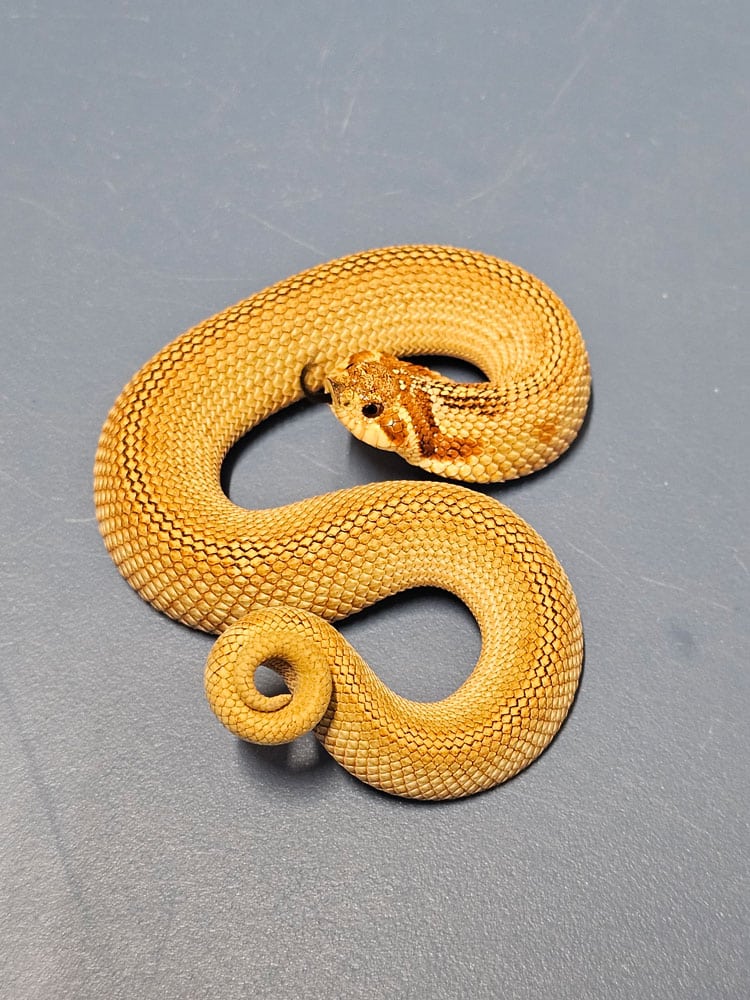
Toffee phase. Photo by Jeff Galewood, Jr.
One effective method for quickly removing a hognose snake that has bitten you is what I like to call the “Pop can tab method.” This involves gently pulling up on the rostral scale (the large upturned scale at the end of their nose) while holding onto the back of their head with yoru middle finger and thumb. Slowly increasing pressure will overpower them, allowing you to safely remove them without causing harm. It may be necessary to gently rock back and forth to unhook their teeth from your skin.
Once removed, place the snake back into its enclosure while still holding it behind its head and release it.
While this experience may seem daunting,
it is indeed not painful unless they bite a sensitive area.
Even then,
the discomfort is minimal.
Frequently Asked Questions About Hognose Bites:
Is hognose venom similar to bee or wasp venom?
No,
in fact,
these venoms are very different from each other.
While both cause a histamine response in humans when injected,
hognose venom serves as a defense mechanism rather than an offensive one.
Their venom is designed to subdue struggling prey through gradual administration via chewing motions.
Therefore, prompt removal of a hognose snake will likely prevent any effects from their venom.
I highly recommend learning how to safely remove a hognose snake in case of an accidental bite.
I have a video demonstration pinned on my Instagram and YouTube channels for reference.
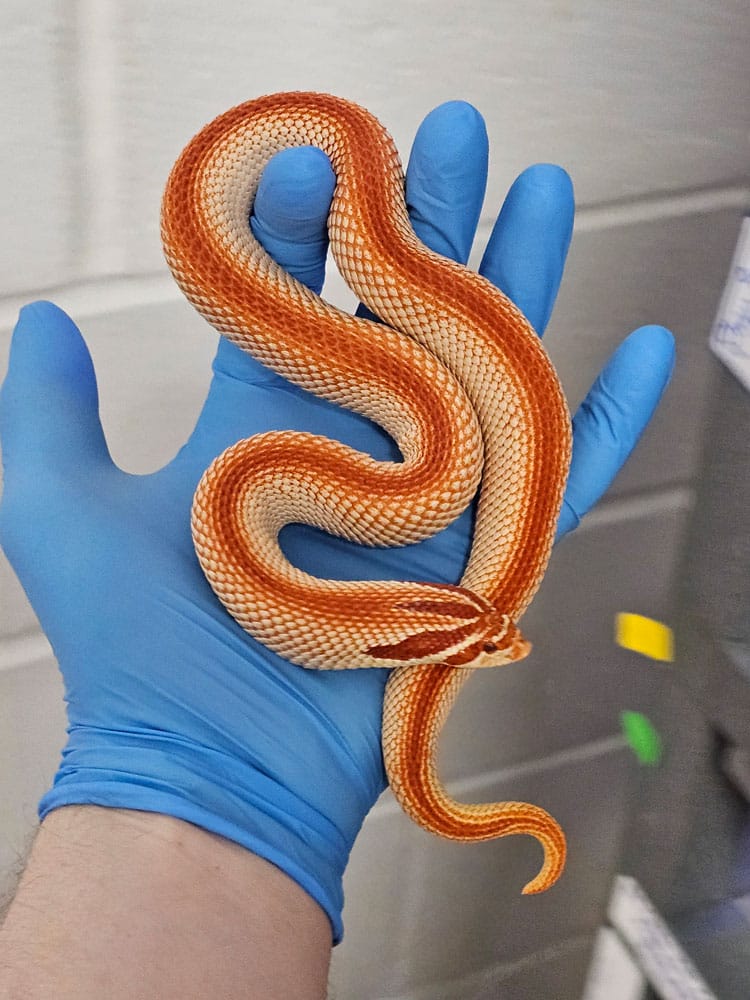
Striped hognose.Photo by Jeff Galewood, Jr.
It’s important to note that while Plains hognose snakes may be mildly venomous,
they are not dangerous and make fascinating pets or educational animals.
With proper handling techniques and knowledge about their behavior,
these unique creatures can bring joy and wonder to anyone who encounters them. So next time you come across a Western hognose snake, remember that the hog knows best!
Paraphrased Article:
A video on YouTube is available for those interested in learning about hognose snakes. However, it is important to note that adult supervision is recommended when handling any reptile, especially for children.
Why Permethrin-based Products Should Not Be Used
If you ever need to treat a hognose snake for mites, it is crucial to avoid using Permethrin-based products such as no pest strips, Prevent o Mite or Black Night products. These are highly toxic and can be harmful to hognose snakes. Rather, consider using diatomaceous earth baths or sprinkling it throughout the enclosure with limited areas for mites to hide. Another safe alternative is washing the snake with Dawn soap and water while gently massaging between the scales and applying mineral oil afterwards.
Tips for Hognose Snake Enclosures
The ideal setup for a hognose snake should be tailored towards their small semi fossorial/terrestrial nature. Many breeders prefer using ARS Caging Systems,specifically the Mini series for babies with polycarb clear tubs,10 series for juveniles and subadults,and 50 series for adult females and large males. alternatively,bioactive terrariums can also be used as they offer more options.
For baby hognoses, smaller enclosures are generally recommended as they provide enough space to crawl around and grow comfortably while also making them feel secure in their surroundings. Though, larger bioactive or naturalistic setups can also be used but may result in decreased appetite in some individuals.
Some breeders start off their babies in 6 quart Tupperware containers with a small heating pad on one side and shallow bedding as another option until they reach around 15-20 grams. Once they have gained more confidence and are larger in size, they can be upgraded to a larger setup.
Enclosure Setup for Sub Adult and Adult Hognose Snakes
Similar to babies, it is important to provide enough space for sub adult and adult hognose snakes to stretch out comfortably. Bioactive or naturalistic setups with plenty of hides and structures are highly recommended, but keep in mind that hognose snakes have a tendency to dig and explore their surroundings which may result in uprooting plants or getting stuck in small holes. It is indeed crucial to ensure that any structures or hides do not have narrow gaps or holes that the snake can get stuck in.
Choosing the Right Bedding
Coarse aspen sani chips, aspen shavings, or bioactive substrates are all suitable options for bedding. Some breeders also mix coco coir with coarse sand as it replicates loam which is found in the central plains where hognose snakes inhabit.
Proper Heating Requirements
Adequate thermogradient is essential for maintaining a healthy body temperature for hognose snakes. This means having one side of the enclosure cooler than the other side which should be kept at a hot spot of 88-96 degrees Fahrenheit (31.1-35.6 degrees Celsius). This allows them to thermoregulate their body temperature by moving between warm and cool areas of their enclosure. It is indeed also recommended to maintain an ambient temperature of 74-80 degrees Fahrenheit (23.3-26.7 degrees Celsius) throughout the enclosure.
To achieve this thermogradient, heating pads or overhead lighting can be used depending on personal preference.
The Importance of Water
Hognose snakes require a wider and lower water dish that they can easily access. It is important to frequently clean their water as stagnant water can grow bacteria which can be harmful to the snake’s health. Tall dishes should be avoided as they may cause some individuals to become dehydrated if they are unable to reach the water.Shallow dishes on the cool side of the enclosure are ideal.
Humidity Levels for Hognose Snakes
Hognose snakes thrive in humidity levels between 40-70%.Providing a humid hide filled with damp coco coir, sphagnum moss, peat moss, or a mix of sand and these mediums can help maintain proper humidity levels.
Ideal Hides for Hognose Snakes
Plains hognose snakes typically inhabit prairie habitats and utilize abandoned rodent burrows or hide in grass clumps. When setting up hides,it is important to ensure that there are no narrow gaps or holes that the snake could get stuck in. Some breeders have had success using tubes or other structures as hides for their hognoses.
Growth and Shedding
Hognose snakes do not shed as often as other commonly kept colubrids, with an average shedding cycle of 3-4 months but some individuals may go up to 5 months between sheds. To prevent dysecdysis (stuck shed),misting them while in shed or providing a humid hide is recommended.
Breeding Size
Adult male hognoses typically range from 16-24 inches in length with some reaching up to 25 inches. Females are larger and more robust than males with shorter tails, ranging from 21-30 inches depending on age and growth rate. For breeding purposes, females should be at least 2-3 years old and weigh around 150-200 grams. However, some breeders have had success with smaller females as long as they are mature in age.
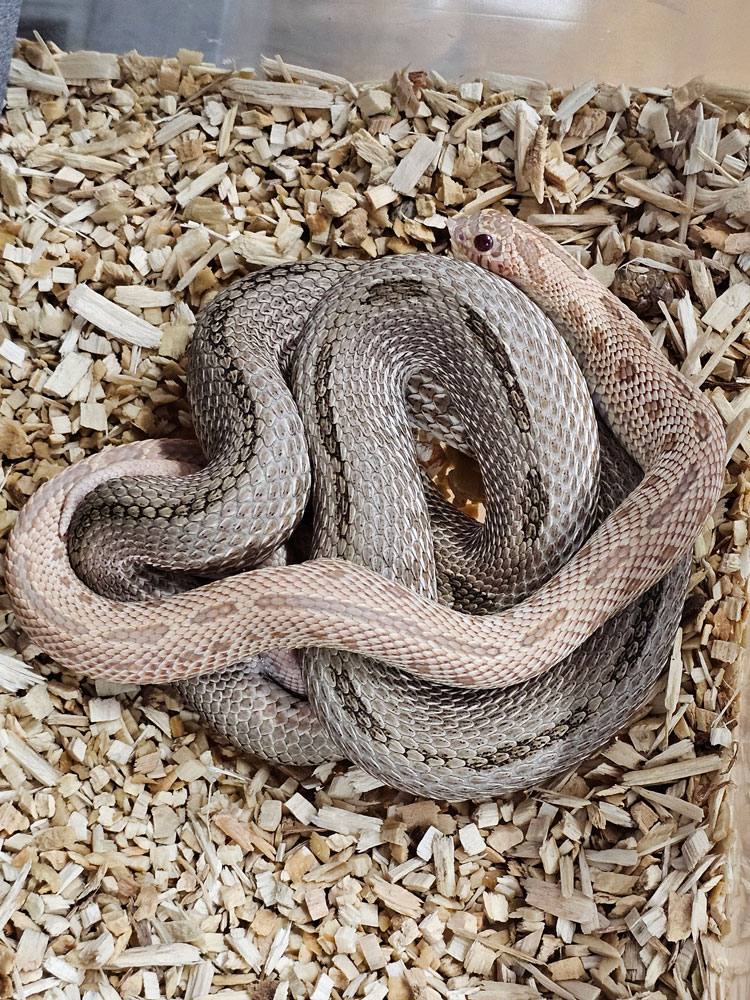
Hognose snake pairing. Photo by Jeff galewood, Jr.
It is important to note that hognose snakes are not picky when it comes to breeding partners and can successfully breed with individuals of similar size and age. Breeding pairs should be introduced during the cooler months of the year (October-January) for optimal results.
My mature female hognose snakes typically range from 26 to 30 inches in length and weigh between 220 and 400 grams. However, I have seen some giant females over 36 inches in length. In captivity, hognose snakes tend to grow larger than their wild counterparts due to consistent metabolism spikes caused by being kept at high temperatures and fed frequently on a rich, fatty mouse diet. While this may result in oversized snakes, it is important for females to attain these sizes gradually over a period of four or more years.
Feeding baby hognose snakes can be challenging as they are not typical ambush predators like other snake species. They rely on both ambushing prey and actively hunting for food. To replicate this behavior in captivity, I recommend offering food directly in front of their face or even gently touching the food against their mouth until they become interested and begin eating.
For first-time feedings with newly hatched babies, I use a frozen-thawed pinky mouse that has been slightly torn at the nose for some blood. I then dip the pinky’s head into water before placing it against the baby’s mouth so they can drink and taste it concurrently.This method works well with different scents if the baby does not find the taste of a pinky appealing.
Some popular scents for stubborn babies include sardine, tuna, salmon (using canned fish in water), chicken bone broth, frog, toad, lizard or gecko puree on scent strips made from gauze dipped into the puree mixture. Live pinky mice can also be used as their movement and smell can trigger a feeding response.
On my Instagram account Repsintx (https://www.instagram.com/repsintxscent), you can see videos of my hognose snakes playing dead - one of their well-known defense mechanisms. This behavior is more common in wild hognose snakes, but captive individuals can also exhibit it.
while hognose snakes may require some extra care and attention when it comes to feeding, they make fascinating and rewarding pets. With proper handling and a varied diet, these unique snakes can thrive in captivity.Scent strips are a popular product sold by repsintx Scent Strips. These strips are highly effective when made correctly, as they combine strong odors of the natural prey that baby plains hognose snakes typically eat, such as lizards and amphibians. Though, replicating the scent of lizard eggs can be challenging. Some breeders have had moderate success using egg yolk or gecko eggs to scent their strips.
If a baby hognose snake refuses its first three meal offerings, it is indeed recommended to try scenting the food with these strips. Notably unlike some other species of snakes, hatchling hognose snakes shed within hours or a couple days after hatching. While some may start eating shortly after shedding, it is best to wait around a week before offering their first meals.
Hatchling hognose snakes can vary greatly in size and weight. In extreme cases, they can weigh under 3 grams while rare runts may only weigh 1-2 grams. On average, babies range from 4-7 grams but there are also larger individuals that hatch at sizes of 8-11 grams. The record weights for hatchlings are around 13-14 grams.
Feeding Guidelines
the following guidelines provide recommendations for prey size based on the weight of your baby hognose snake:
- Prey size for micro hogs (3g and under) – small pinky head
- Prey size for 4g -6g hogs – extra small pinks
- Prey size for 7g -9g hogs – small to medium sized pinks
- Prey size for 10g -15g hogs – medium to large pinks
- Prey size for 16g -25g hogs – large pinks to peach fuzzy mouse
- Prey size for 26g -40g hogs – peach fuzzy to fuzzy mouse
- Prey size for males (40-70g) – one to two fuzzy mice
- Prey size for females (40-70g) – one to three fuzzy mice
Note that the sizes of prey items may vary slightly between suppliers. As a general rule, the prey item should be slightly thicker than the center mass of your snake. For young snakes, it is recommended to feed them every 5-7 days.
Males weighing 70 grams and above may experience a slower metabolic rate and growth. It is indeed critically important not to overfeed them and keep them fit and healthy. A hopper mouse or two or a couple of fuzzy mice are suitable prey options for these larger males. If they refuse food, it could be a sign that they are ready to breed or preparing for brumation due to seasonal changes. adult males may also eat less frequently as their metabolism slows down and they have ample fat reserves.
Females weighing 70 grams up until maturity can have voracious appetites as they continue growing. It is indeed recommended to feed them enough so that there is a visible lump in their body after eating.This can be achieved by offering small hopper mice or multiple fuzzy mice at each feeding session. Larger females can start being fed small adult mice but it is indeed critically important not to overfeed them with one big meal as hognose snakes do better with digesting smaller meals more frequently.
Alternative Prey Options
Along with conventional prey items, there are alternative options that you can offer your hognose snake. These include hard boiled chicken eggs (peeled and chopped into bite size pieces), button quail eggs, silver side fish, frog leg meat, quail, balut (without shell), certain reptile diet sausages (Reptilinks), and in rare cases ethically produced and raised feeder toads, frogs, or lizard species.Though, these options might potentially be more tough to obtain at an affordable price.
In the wild, hognose snakes have a varied diet consisting of reptile eggs, lizards, amphibians, rodents, bird eggs and fledglings that nest on the ground. They may also occasionally eat other snakes.The central plains and prairie habitats where they are found experience droughts and temperature fluctuations which result in a healthy varied diet for hognose snakes. This natural cycle also causes their metabolism to spike and drop more frequently compared to captive care where they are kept at constant summer-like temperatures and fed too frequently as adults. To mitigate this issue in captivity it is important to practice portion control.
In the wild hognose snakes do not feed as frequently as they do in captivity. as females approach maturity it is recommended to reduce their feeding frequency from every 7 days down to every 10-12 days once they reach around 120 grams in weight. After their first breeding season when females have regained all of their weight back it is indeed recommended to feed them every 10-14 days depending on their body condition. Some larger females may only need food every 14-21 days while others may require more frequent feeding if they are leaner or gaining too much weight.
Breeding
Simulating a seasonal change through brumation is crucial for triumphant breeding results with plains hognose snakes. In the wild these snakes experience cold winters regardless of whether they live in northern or southern locales. Brumation helps to put their bodies into a reproductive state and also helps to organize when they can be bred. Hognose snakes have evolved over millions of years, adapting to the seasonal changes in their surroundings. Thus, it is indeed critically important to simulate this natural cycle in captivity.
How to Brumate
Before cooling your hognose snake for brumation it is important that they have an empty digestive tract. To achieve this,do not feed them for 20 days while keeping their heat source on.After this two week period turn off the heat source and keep them at room temperature (70-77 degrees Fahrenheit or 21.1-25 degrees Celsius) for another week to 12 days before putting them into brumation.
You can use a cellar or other controlled environment that stays between the temperatures of 40-60 degrees Fahrenheit (4-15 degrees Celsius). It is indeed recommended to keep them mostly dark during this time as well. Some breeders use wine coolers for brumation but it is important to choose one with less vibration such as a thermoelectric wine cooler rather than a compressor wine cooler.
Paraphrased and restructured article:
Brumation is an essential part of the breeding process for hognose snakes. While females should be brumated for approximately two months, males only need about a month of brumation. To simulate their natural environment, you can place them in smaller containers with a mixture of lightly damp coco coir and sand, mimicking an abandoned rodent burrow. This slightly moist substrate will help keep them hydrated during their period of dormancy.
It is important to offer water to the snakes during brumation, regardless of whether they are on dry or damp substrate. However, they may not drink as much at cooler temperatures due to their lower metabolic rate.
In certain specific cases, female hognose snakes may not even get thirsty during the entire brumation period as their body conserves water and the damp soil prevents them from drying out. It is indeed also possible to take them out of brumation intermittently for a day or two at room temperature to ensure they are active and healthy before putting them back into cool down.
after coming out of brumation, it is indeed recommended to leave the snakes at room temperature for 2-3 days before returning them to their regular setups. When setting up their enclosure again, it is important not to instantly increase the heat but rather maintain a hot spot between 82-86 degrees Fahrenheit (27.8-30 degrees Celsius) throughout the breeding season while keeping ambient temperatures in the mid-upper 70s.
Offering small meals around five days after coming out of brumation followed by another meal five days later (normal size meal) is recommended before starting pairing attempts. For males, it is not as crucial that they are fed prior to pairing as long as they have good weight.
It should be noted that males should never be paired while having food in their digestive tract as this increases the risk of regurgitation due to their increased activity during courtship. On the other hand, females can be paired with a full stomach provided that they are not showing signs of distress or trying to escape from the male.
When introducing a male and female hognose snake, it is common to see them excitedly waving their tails and twitching their bodies. This is an instinctive reaction when encountering another hognose snake and serves as a way for them to communicate with each other. The male will often follow the female around, exhibiting behaviors such as crawling with her or “surfing” on her back, which are positive signs of receptivity.
If these behaviors do not occur immediately, do not be discouraged as some snakes may take longer to become acquainted and receptive. It is recommended to pair snakes around two weeks after brumation,but some females may not allow a male to lock for up to a month after brumation.
It is important to keep an eye on the snakes during pairing attempts,especially within the first hour when there is a higher risk of cannibalism. While this behavior is not common in hognose snakes, it can still occur and should be taken seriously. To mitigate this risk, make sure that both snakes are well-fed before pairing and consider using multiple males if necessary.
After successful breeding has occurred (indicated by locking), it is recommended to leave the male with the female for several days at a time before separating them for feeding purposes. It is indeed critically important that the female recognizes that the male hognose snake is not food when they are reintroduced after feeding.
To give males time to rest and recover between pairings, it is recommended to wait at least seven days before attempting another pairing session. Multiple males can also be used simultaneously in certain situations where one or two females may need extra stimulation for breeding behavior.
It should also be noted that some males may show no interest in certain females but readily court others. In these cases, it is best to pair snakes with the same genetics to increase compatibility and success rates.
During the breeding season, it is indeed critically important to supplement hognose snake prey with calcium and other essential nutrients such as Zoo Med Calcium without d3, Miracle Care’s Vionate, and Zoo Med reptivite.
Copulation typically lasts a few hours, with some locks lasting up to 13 hours.After breeding has occurred, it is indeed recommended to remove the male from the female’s enclosure and mark down the copulation date for record-keeping purposes. it is generally not recommended to re-pair snakes after successful breeding has occurred.
Once a female becomes gravid (pregnant), she will have a pre-lay shed before laying her eggs. this can be identified by scale separation and swelling in the lower portion of her body. To prepare for egg-laying, an egg box (a Tupperware container filled halfway with loamy soil) should be introduced into their enclosure. The substrate can consist of coco coir, peat moss, vermiculite, sphagnum moss or a mix of these materials.
If the female does not seem interested in using an egg box or frequently digs outside of it, you can make their entire enclosure an egg box by adding lay box substrate throughout with hides for nesting purposes.
The average time between pre-lay shed and laying fertile eggs is between seven and 11 days but may vary depending on ambient temperatures.Clutch sizes can range from just a few eggs up to over 30 for record-breaking clutches.
Incubation should take place at temperatures between 78-82 degrees Fahrenheit (25.6-27.8 degrees Celsius) in coco coir mixed with sand in a Tupperware container with small air holes for ventilation. On average incubation takes between 51-60 days at this temperature range but may vary.
It is important to quarantine and monitor the health of hognose snakes, as they can be susceptible to certain ailments such as dry nose. This can be caused by poor husbandry, low humidity, or dusty substrate. To treat this issue, soak the snake and apply betadine or Vetericyn to the affected area while also increasing humidity and providing a humid hide.
breeding hognose snakes requires careful attention to detail and proper husbandry practices. by following these tips and guidelines, you can increase your chances of successful breeding and healthy offspring.How to Properly Quarantine and Care for Your Hognose Snake
Hognose snakes are popular pets due to their unique appearance and docile nature. However, like any other animal, they can be susceptible to various diseases and infections. As a responsible pet owner, it is indeed critically important to know how to properly quarantine and care for your hognose snake in order to prevent the spread of illnesses.
Round Worm: Symptoms,blood in stool,digestive upset,sporadic appetite at times. Requires a stool test. Goat dewormer/panicur is the main medicine prescribed and is over the counter.
Bacterial Infections: Hognose snakes are prone to bacterial infections caused by dirty water, dusty dry stool particles on the bottom of the enclosure, poor air circulation, or a dirty environment. these infections can be difficult to diagnose and even low-grade sepsis may be dismissed by a veterinarian as not having an infection. It is important to keep your hognose clean with good air flow in order to prevent these types of infections from occurring. Symptoms may include lethargy, weight loss or lack of growth, odd colored stools, lack of appetite or nausea in extreme cases.
Cryptosporidium: This single-celled organism parasite can have a huge impact on your colubrid collection if left untreated. It is important to get a proper lab test diagnosis as it can be asymptomatic and hard to pinpoint without testing. Currently there is no cure for cryptosporidium and different species or strains may affect your snake differently. To prevent this disease from spreading through your collection it is crucial that you buy snakes from trusted sources that have experience with cryptosporidium and practice proper quarantine procedures before introducing them into your collection.
Symptoms of cryptosporidium include regurgitation, watery pale stools (which can vary greatly), indentation on the underside of their tail, dehydration, weight loss, pale appearance in progressed stages, liver failure, rapid weight loss and atrophy. To prevent the spread of this disease it is important to buy from a trusted source and wear gloves when handling different animals. It is indeed also recommended to keep newly hatched babies separate from adults if there is concern that the adults might potentially be carriers.
How to Quarantine: It is recommended to permanently quarantine any newly acquired hognose snakes before introducing them into your collection. Only eggs from the quarantine section should be added to your collection in order to ensure that you are hatching clean babies. This is because cryptosporidium is not transmitted through the blood stream but via stool.
Don’t let these potential diseases scare you away from owning a hognose snake. By purchasing from a reliable and knowledgeable source and following proper quarantine procedures, you can greatly reduce the risk of your snake becoming ill. Remember that prevention is key when it comes to keeping your pet healthy.as a responsible pet owner it is important to educate yourself on how to properly care for your hognose snake and prevent the spread of diseases within your collection. By following these guidelines and purchasing from trusted sources, you can ensure that your hognose will live a long and healthy life with you as its owner.
One of my biggest inspirations for keeping and breeding reptiles was REPTILES magazine. My dad had a monthly subscription since the early 90s which I would eagerly go through as a kid. I am grateful for REPTILES magazine’s continued inspiration for future generations of reptile enthusiasts like myself.
Thank you for this opportunity.
Jeff Galewood Jr.
Instagram: instagram.com/jmgreptiles


I’ve always been fascinated by hognose snakes, thanks for this guide!