
Rat snakes are a common and successful species found in the United States and other regions around the world. They are also popular among reptile keepers due to their attractive colors and ability to thrive in captivity. Despite their prevalence, there is one rat snake species in particular that always captures attention and interest – the Trans-Pecos rat snake (Bogertophis subocularis).
This unique and attractive species stands out with its distinctive coloration,docile nature,pink tongues,and large,curious eyes. When asked which of my snake species is their favorite, my friends and guests frequently enough choose the Trans-Pecos rat snake - earning them the nickname “the ‘eyes’ have it.”
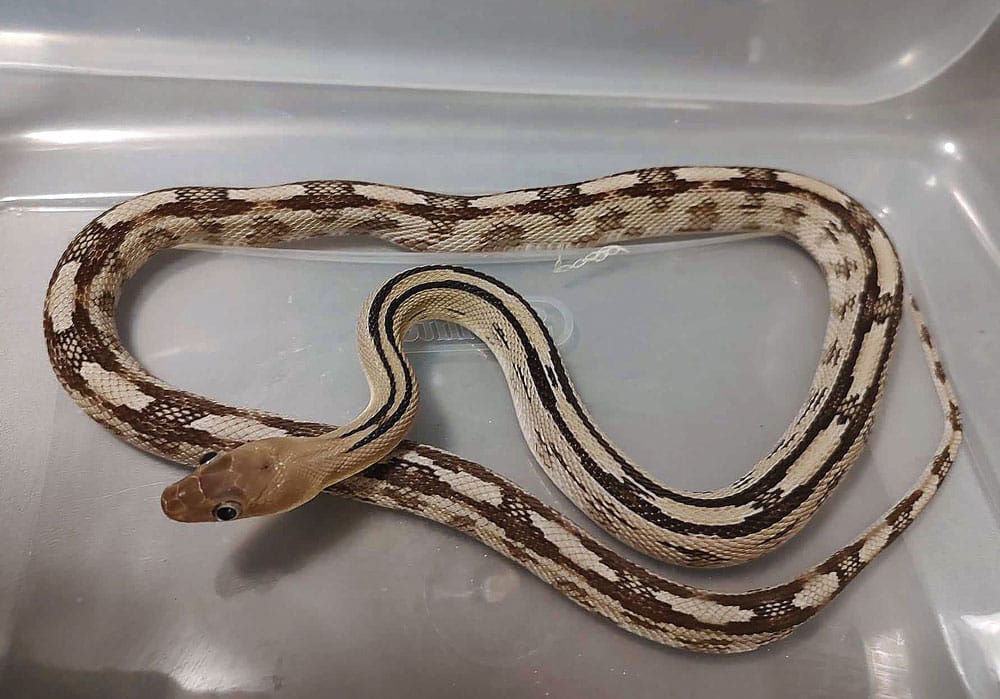
Trans-Pecos rat snake. Photo by David Powell
The non-venomous Trans-Pecos rat snake thrives in a harsh desert environment that many other animals cannot survive in. This colubrid species is native to west Texas and parts of New Mexico in the U.S., and also Chihuahua, Coahuila, Durango, Nuevo Leon states in Mexico. Its common name comes from its range west of the Pecos River, known as the Trans-Pecos region, and it is also referred to as the Davis Mountain rat snake.
The Trans-Pecos region is part of the Chihuahuan desert – the largest desert in North America. Despite its harsh conditions, this area boasts a high level of biodiversity due to its unique plants and animals. As a Texas native and photographer, I have made numerous trips to this region and am always amazed by the abundance of reptilian life, stunning sunsets, and starry night skies. It truly is a peaceful and awe-inspiring experience.
Trans Pecos Rat Snake Natural History
The Trans-Pecos rat snake was first documented in 1901 by herpetologist Arthur Brown. Brown was the superintendent of the Philadelphia Zoological Gardens – America’s first zoo (Brown, 1901). He also discovered another species in my collection – the Gray-banded king snake (Lampropeltis alterna). The scientific name for this species comes from its unique row of subocular scales around its large eyes that allow it to hunt at night using starlight or moonlight.
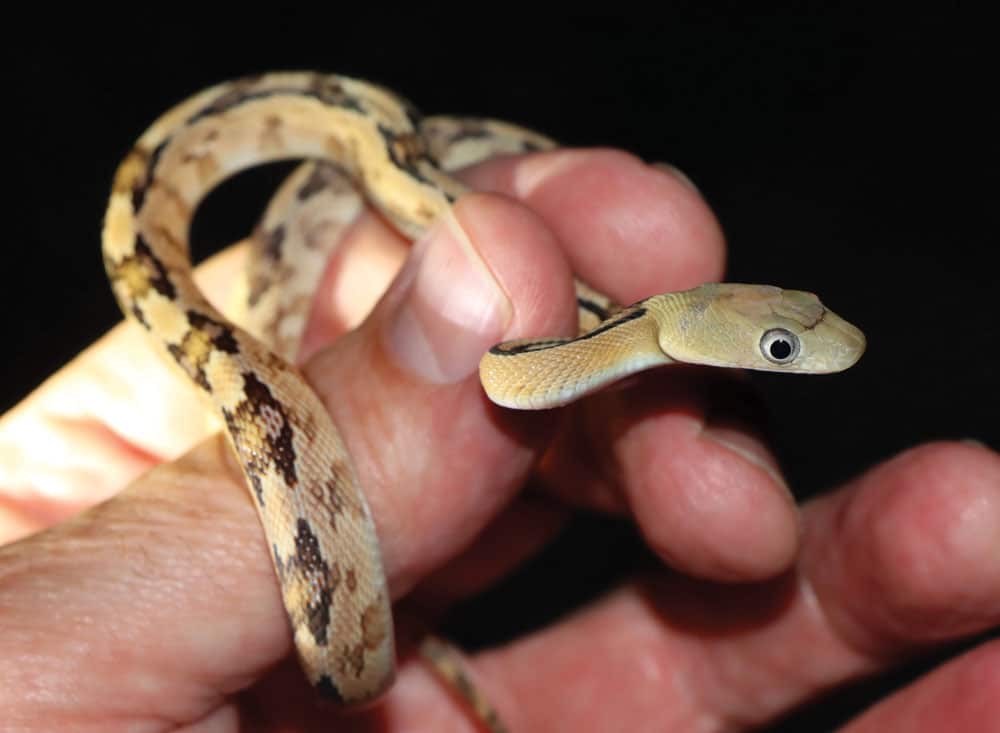
A neonate. Photo by Russell Rozell
While other snakes have adapted to survive in harsh desert environments, the Trans-Pecos rat snake’s large, sensitive eyes give it a unique advantage for hunting at night. This adaptation sets it apart from other desert snake species that rely on heat-sensing pits and venom delivery systems. The Trans-Pecos rat snake is one of onyl two species in the Bogertophis genus, with the other being the Baja California rat snake (Bogertophis rosaliae) found on the baja peninsula in southern Mexico.
California and Baja California, Mexico. The Subocularis species was previously classified under the Coluber and Elaphe genera before being reclassified as a member of the Bogertophis genus in 1988.
It is intriguing to note that the Trans-Pecos rat snake has been placed in three different genera within a span of less than 100 years. However,it is widely agreed upon that this snake possesses distinct characteristics that set it apart from other rat snakes,racers,whipsnakes,and coachwhips. Therefore,it rightfully deserves its own genus. In fact, its current classification as Bogertophis is a tribute to American herpetologist Charles M. Bogert who served as the chairman and curator for the department of herpetology at the American Museum of Natural History from 1943 to 1968.
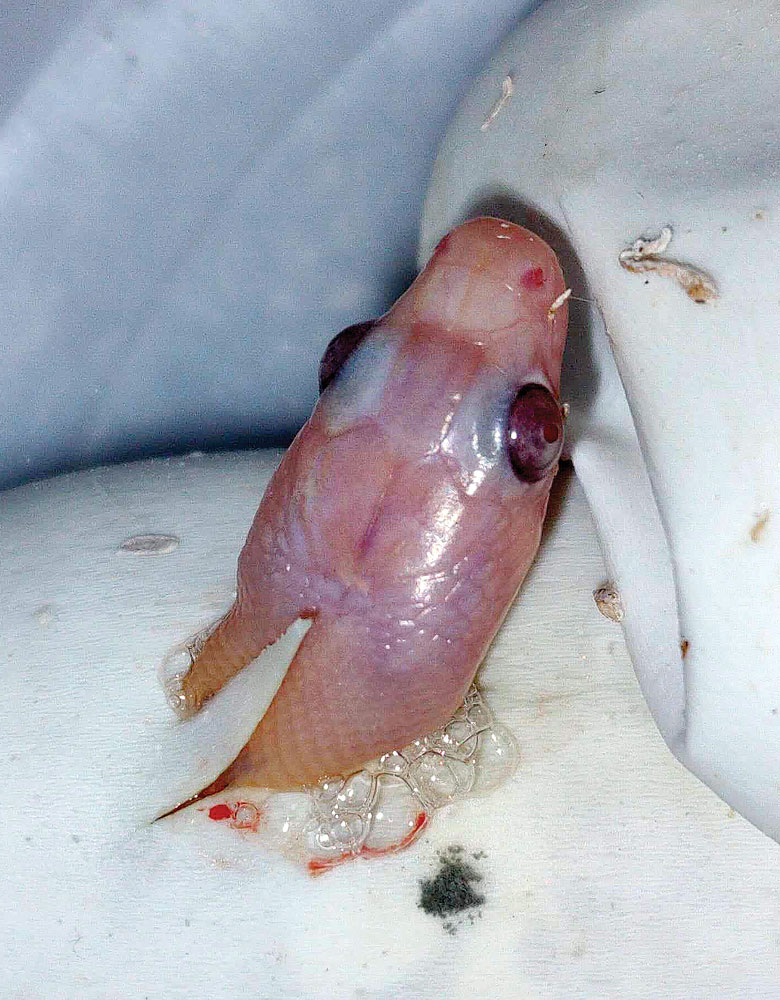
A Trans-Pecos rat snake emerging from its eggshell fragments. Photo by David Powell
In addition to their unique head and eye structure, these snakes are also known for their striking dark brown or black “H” shaped dorsal markings against a sandy or beige background coloration. These markings consist of vertical bars intermingled with light orange, yellow, or brown markings, creating two multi-colored stripes along the length of the snake’s dorsal area. This coloration allows them to blend in seamlessly with their natural habitat in the Chihuahuan desert.
There are several other color variations within this species. As a notable example,there is a “blond” phase found in the lower Pecos river watershed in Brewster County,Texas that displays lighter coloration and fewer dorsal markings. Another variant from the Franklin Mountains in far west Texas has a steel-grey background coloration. The head of a Trans-Pecos rat snake is unmarked and its abdomen is a pristine pearly cream color. Many Subocularis specimens also have light grey or even light blue luminescent eyes,adding to their overall appeal and beauty. Their distinct coloring and markings make them an iconic species of the American southwest and Mexico.
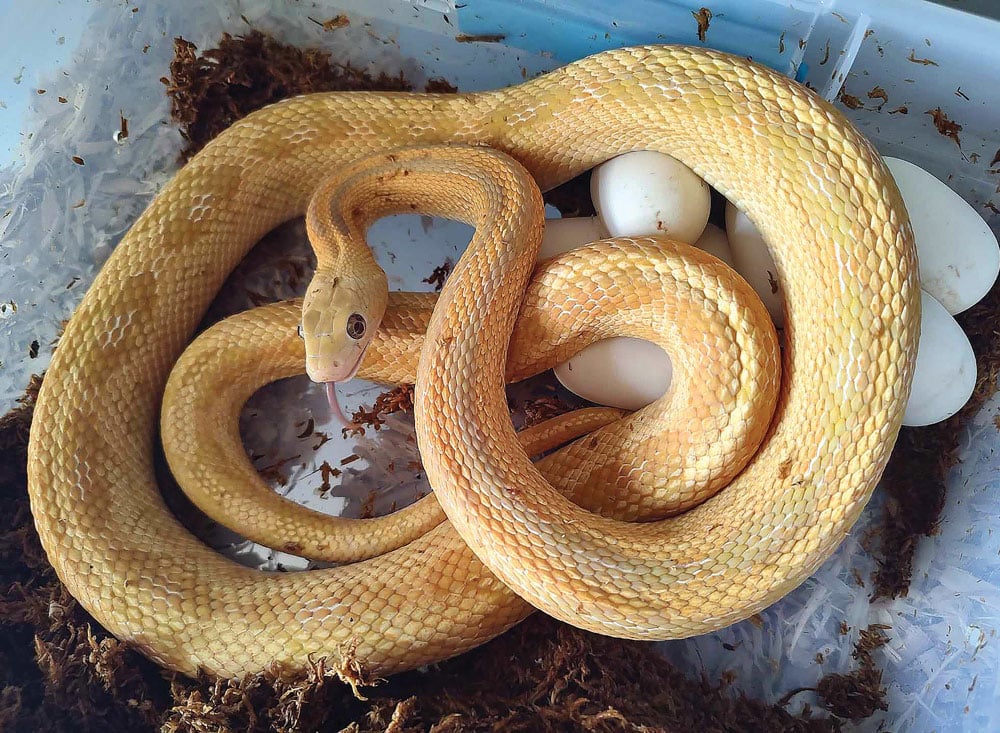
A female Trans-Pecos rat snake protecting her clutch of eggs. Photo by David Powell
this species was famously described by renowned herpetologist Carl Kauffeld in his book “Snakes: The Keeper and the Kept.” He dedicated an entire chapter to these snakes titled “The Search for Subocularis” due to his fascination with them (Kauffeld, 1969). For those interested in snakes, I highly recommend reading Mr. Kauffeld’s work, although the books are currently out of print and only available as used copies. Curator Kauffeld is also known for amassing a complete collection of all 32 U.S. rattlesnake species for display at the Staten Island Zoo where he worked from 1936 to 1963 – an notable feat indeed! Here is what he wrote about the Trans-Pecos rat snake:
“No doubt aesthetic gratitude of snakes is the result of long conditioning, yet many of my non-herpetological friends agree with me and seem to understand my enthusiasm for this creature. Perhaps they are only being kind,humoring my eccentricity,but to me,insignificant as this individual snake is among myriad animal forms,infinitesimal as we all are in the universe as a whole,it represents beauty and perfection-‘fashioned by loving hands,’ as one would say a work of art.” (Reprinted with permission) These words from an esteemed herpetologist serve as an inspiration.
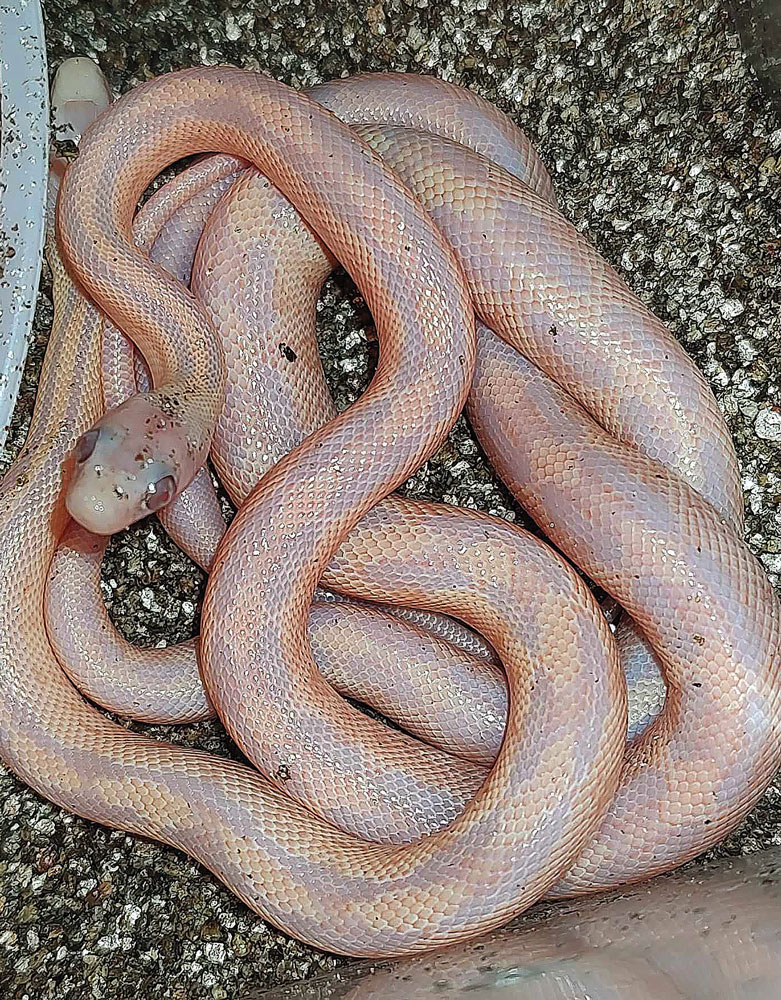
An albino neonate Trans-Pecos rat snake. Photo by David Powell
This species was famously described by renowned herpetologist Carl Kauffeld in his book “Snakes: The Keeper and the Kept.” he dedicated an entire chapter to these snakes titled “the Search for Subocularis” due to his fascination with them (Kauffeld, 1969). For those interested in snakes, I highly recommend reading Mr. Kauffeld’s work, although the books are currently out of print and only available as used copies. Curator Kauffeld is also known for amassing a complete collection of all 32 U.S. rattlesnake species for display at the Staten Island Zoo where he worked from 1936 to 1963 – an impressive feat indeed! Here is what he wrote about the Trans-Pecos rat snake:
“No doubt aesthetic appreciation of snakes is the result of long conditioning, yet many of my non-herpetological friends agree with me and seem to understand my enthusiasm for this creature. Perhaps they are only being kind, humoring my eccentricity, but to me, insignificant as this individual snake is among myriad animal forms, infinitesimal as we all are in the universe as a whole, it represents beauty and perfection-‘fashioned by loving hands,’ as one would say a work of art.” (Reprinted with permission) These words from an esteemed herpetologist serve as an inspiration.
David-Powell100.jpg 781w, https://reptilesmagazine.com/wp-content/uploads/2025/12/Trans-pecos-rat-snake-albino-neonate-david-Powell100-400×512.jpg 400w, https://reptilesmagazine.com/wp-content/uploads/2025/12/Trans-pecos-rat-snake-albino-neonate-David-Powell100-650×832.jpg 650w, https://reptilesmagazine.com/wp-content/uploads/2025/12/Trans-pecos-rat-snake-albino-neonate-David-Powell100-250×320.jpg 250w, https://reptilesmagazine.com/wp-content/uploads/2025/12/Trans-pecos-rat-snake-albino-neonate-David-Powell100-768×983.jpg 768w, https://reptilesmagazine.com/wp-content/uploads/2025/
The Trans-Pecos rat snake is a medium to large species of snake that can reach lengths between 36 and 54 inches (90-137 cm), with the largest recorded specimen measuring at 66 inches (167.6 cm) (Powell,Conant,Collins,2016).These snakes are strictly nocturnal and can only be observed at night under specific conditions during certain times of the year within their range. Though,based on my personal experiences in west Texas,these snakes are still relatively common in their natural habitat. like other rat snakes, Subocularis are constrictors and primarily prey on rodents as adults such as pocket mice (Perognathus), cactus mice (Peromyscus), and kangaroo rats (Dipodomys). They have also been known to consume birds and lizards, while neonates and juveniles have been observed eating lizards. Predators of the Trans-Pecos rat snake include raptors, roadrunners, other snakes, skunks, coyotes, foxes, bobcats, badgers, and bears (Ernst and Ernst, 2003). Unfortunately, many of these snakes also fall victim to vehicle collisions on roads.Interestingly enough, Subocs are the only known host for a species of ticks called Robertsicus elaphensis (formerly Aponomma elaphensis). These ticks attach themselves to the snakes’ tails while they are in hibernation and can cause some individuals to lose their tails in the wild. Though, it is indeed believed that these parasites do not cause significant harm besides tail loss or scarring. It is thought that these ticks choose this particular host because sunlight can disrupt their life cycle and subocs rarely venture out into daylight.
Most of our knowledge about Subocularis reproduction comes from captive specimens. They typically reach sexual maturity at around 3-4 years old; however size may be a more significant factor than age. Specifically speaking adult snakes shoudl be at least 40 inches (101.6 cm) in length before they are able to reproduce successfully. Due to being a desert species with shorter brumation periods compared to other temperate climate species.
Breeding occurs between mid-to late June through mid-July which is later than most other snake species’ breeding season. Additionally eggs are laid later in the season during late August through early September time frame resulting in hatching occurring as late as November after an incubation period lasting between 6-8 weeks (Rhoads 2008). These unique breeding parameters further set this species apart from others.
Subocs make excellent captives due to their docile nature; however they can be finicky eaters which may pose challenges for inexperienced keepers. They are extremely calm and tame when handled, with many individuals displaying unique personalities. Even wild subocs I have encountered have not shown aggression towards humans and seem to view us as mere annoyances. As a child growing up in texas, keeping Trans-Pecos rat snakes was a dream of mine that has now become a reality.
Despite their potential picky eating habits, through trial and error I have found a strategy to encourage my subocs to eat regularly. Both my male and female prefer hairless frozen/thawed rats over other rodent offerings with hair on them; my female even refuses hairless mice! My male will consume both hairless rats and mice, occasionally eating fuzzy rats as well.
While some reptile keepers may find these feeding nuances dubious, others can relate to the challenges of getting certain species or individual snakes to eat consistently. It is indeed critically important for keepers to try different methods in order to ensure the health and well-being of their animals.
the Trans-Pecos rat snake is a interesting species with unique characteristics that set it apart from other snake species. Their docile nature makes them excellent captives for experienced reptile hobbyists; however their picky eating habits may pose challenges for beginners. With proper care and attention, these snakes can thrive in captivity while still maintaining their wild behaviors and instincts.Ways to Ensure Your Snake is Healthy
Keeping your snake healthy is crucial for its well-being. There are various methods you can use to achieve this.The first thing to consider when dealing with a snake that is not eating is the temperature of its enclosure. For desert species like the Trans-Pecos rat snake, it’s important to keep the daytime temperature slightly higher than other colubrids. This can be achieved by using a larger under tank heater and maintaining a temperature of 80-85 degrees Fahrenheit (26.7-29.4 degrees Celsius). It’s also important to maintain a relative humidity of 40-50%. Other than these slight adjustments, there isn’t much difference in caring for subocs compared to other rat and king snakes.
When setting up an enclosure for your snake, it’s important to consider their natural habitat. A glass reptile enclosure with a fitted top and an under tank heat pad on one side works well for subocs. the heat pad should cover about 1/3 of the base of the enclosure, but for subocs, it may need to cover more space. It’s also essential to provide at least two hides in the enclosure, one being a humidity box filled with sphagnum moss or another absorbent material. aspen shavings make for suitable substrate and adding branches,logs,and rocks can provide stimulation and create temperature gradients within the enclosure.
Subocs are prone to respiratory illnesses so ensuring good ventilation and keeping humidity levels slightly lower than other snakes is crucial. Incandescent lights work well as lighting sources in enclosures but make sure they go off at night via timers as these snakes require periods of darkness too.
To truly understand how best to care for subocs, reading “The Complete Suboc -A Thorough Guide” by Dusty Rhoads is highly recommended.
With their gentle nature and striking appearance, it’s no surprise that subocs are popular pets. Keeping a trans-Pecos rat snake as a pet can introduce you to a whole new variety of rat snakes. Their captivating dorsal patterns and fascinating survival adaptations make them an interesting addition to any reptile enthusiast’s collection.For many, finding subocs in the wild is an exciting and memorable experience.
References
– Brown,A.E. (1901).A new species of Coluber from west Texas. Proceedings of the Academy of Natural Sciences of Philadelphia 53(2): 492-495 + Plate XXIX.
– Ernst,C., & Ernst E. (2003). Snakes of the United States and Canada. Smithsonian Books.- Kauffeld, C. (1969). Snakes: The keeper and the kept. N.Y: Doubleday and co.- Powell, R., Conant, R., & Collins, J.T.(2016). Peterson field guide to reptiles and amphibians of eastern and central North America, fourth edition.Houghton Mifflin Harcourt.
– Rhoads,D.(2008),The complete suboc: A comprehensive guide to the natural history,care,and breedingoftheTrans-PecosRatsnake.ECOHerpetologicalPublishing&Distribution.
keeping your snake healthy requires attention to detail in terms of temperature control, humidity levels, enclosure setup,and providing proper care based on their natural habitat.It’s also essential to educate yourself on specific species like subocs through reliable resources such as books or reputable websites.This will ensure that your snake remains healthy for years to come while also providing you with endless enjoyment as a pet owner!

This is really fascinating, I never knew there were such specific care requirements for this type of snake. Thanks for the info!